
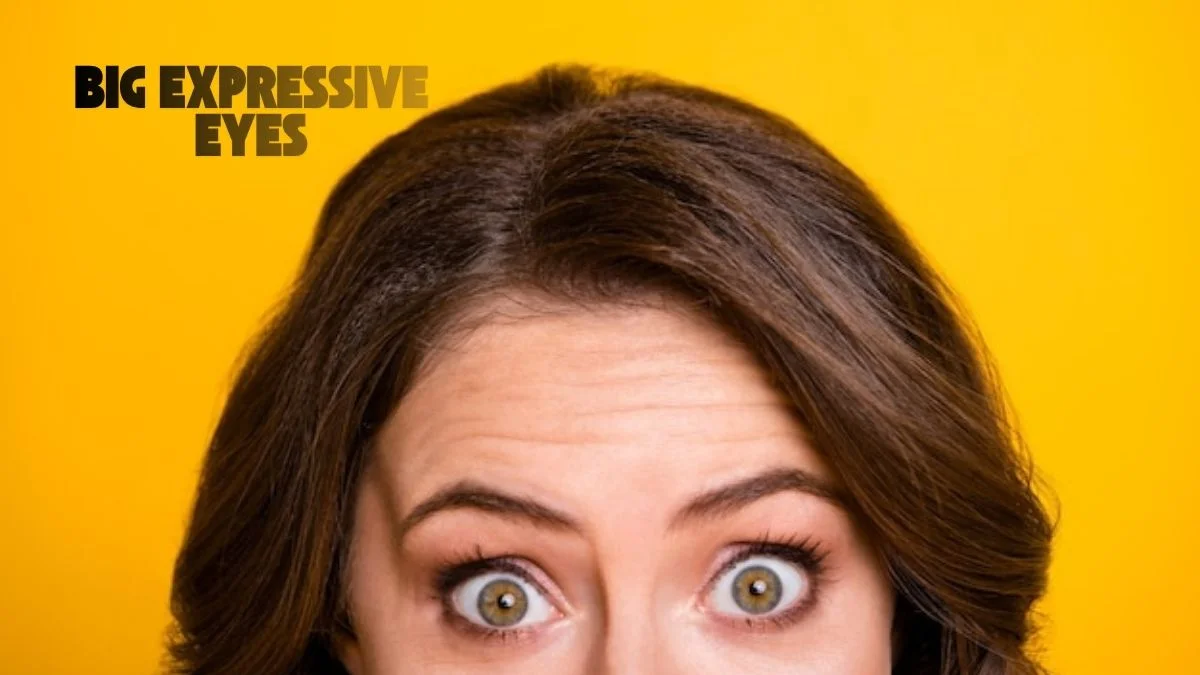
There is a reason why a single glance can stop a scene cold. Big expressive eyes have fascinated audiences, directors, and beauty enthusiasts for well over a century — and their power likely extends far beyond aesthetics into the realm of human psychology and nonverbal communication.
From the silver screen to social media feeds, the gaze of an actress or performer with strikingly large, emotive eyes is often cited as the single most memorable feature of their on-screen presence. This guide explores the cultural origins, the science behind visual appeal, and the modern beauty frameworks that celebrate this feature — while spotlighting the Hollywood talent that has turned wide, expressive eyes into a signature art form.
The Origins — Where the Fascination Began
The cultural obsession with large, luminous eyes is likely as old as portraiture itself. Ancient Egyptian art stylized the eyes with kohl and elongated lines, suggesting a deep cultural reverence for the eyes as windows to emotional and spiritual life. Renaissance painters consistently rendered their subjects with wide, reflective eyes to signal innocence and virtue.
In Hollywood’s golden era, silent film actress Lillian Gish was among the first performers whose career was arguably built on the communicative power of her wide-eyed gaze. Without dialogue, her eyes narrated entire emotional landscapes — a technique that arguably laid the foundation for what audiences would come to expect from expressive-eyed performers across every genre.
The 1960s mod fashion movement amplified this further. Twiggy — born Leslie Hornby and one of the era’s most iconic supermodels — became globally recognized partly because of her dramatically emphasized doe eyes.
The Visual Science Behind Big Expressive Eyes
Neoteny and the Perception of Depth
Research in evolutionary psychology suggests that large eyes relative to facial proportions are associated with neoteny — the retention of juvenile features into adulthood. Studies in social cognition indicate that observers tend to attribute warmth, trustworthiness, and emotional openness to individuals with proportionally larger eyes, though these associations are culturally modulated and not universal.
From a cinematographic standpoint, directors and directors of photography have long capitalized on this. A close-up of a performer’s eyes — particularly when the iris and sclera fill a significant portion of the frame — may create a heightened sense of emotional intimacy with the audience. This could be one reason why certain actresses with big expressive eyes are described as having a commanding screen presence even in relatively still or understated moments.
The Limbic Resonance Hypothesis
Some behavioral researchers have proposed that large, open eyes may trigger what is loosely termed ‘limbic resonance’ — a neurological attunement between observer and subject. While this remains a hypothesis rather than established consensus, it is frequently referenced in the performing arts to explain why certain performers draw disproportionate emotional engagement from audiences.
It is worth noting that expressiveness itself — the dynamic range of the eyes — may be as important as physical size. Aperture, pupil dilation response, and periorbital muscle movement all contribute to the perceived expressiveness of the gaze, which is why trained actors can convey profound emotional states with eyes that might not be conventionally ‘large’ by anatomical measurement.
The B.E.E. 7-Step Method: Recognizing True Expressive Eye Power
Based on patterns observed across decades of film criticism and aesthetic analysis, we propose the Big Expressive Eyes (B.E.E.) 7-Step Evaluation Framework — a structured lens through which to assess the communicative power of an actress’s gaze:
- Aperture Range — How wide can the eye appear across emotional states?
- Iris Visibility — The ratio of visible iris to total eye opening (higher = more expressive).
- Periorbital Mobility — Range of motion in the muscles surrounding the eye.
- Luminosity Response — How light catches and reflects in the eyes on camera.
- Emotional Specificity — Ability to communicate distinct emotions without facial movement elsewhere.
- Stillness Power — Impact of a motionless, sustained gaze in dramatic moments.
- Contextual Adaptability — The eyes’ effectiveness across multiple genres: comedy, drama, thriller.
Actresses who score consistently high across all seven dimensions of this framework are likely to be remembered not just for their performances but for the visceral emotional impact of their on-screen presence.
Hollywood Icons With Big Expressive Eyes — A Comparison
The following table presents a curated selection of actresses widely celebrated for their visually striking and emotionally resonant gaze, referencing IMDB community lists and critical acclaim:
| Actress | Known For | Eye Characteristic | Notable Performance |
| Audrey Hepburn | Roman Holiday, Breakfast at Tiffany’s | Almond-shaped, wide, luminous | Breakfast at Tiffany’s (1961) |
| Anne Hathaway | Les Misérables, The Princess Diaries | Large almond eyes, warm depth | Les Misérables (2012) |
| Amanda Seyfried | Mamma Mia!, Mean Girls | Wide blue eyes, innocent depth | Mamma Mia! (2008) |
| Mila Kunis | Black Swan, That ’70s Show | Hazel eyes, high intensity | Black Swan (2010) |
| Zooey Deschanel | New Girl, 500 Days of Summer | Deep blue, wide-set, dreamy | 500 Days of Summer (2009) |
| Marion Cotillard | La Vie en Rose, Inception | Deep, soulful, film-noir depth | La Vie en Rose (2007) |
| Anya Taylor-Joy | The Queen’s Gambit, The Witch | Wide-set, otherworldly pale | The Queen’s Gambit (2020) |
| Penélope Cruz | Volver, Vicky Cristina Barcelona | Intense dark brown, passionate | Volver (2006) |
Big Expressive Eyes in Modern Beauty Culture
Makeup Techniques That Likely Enhance Eye Expressiveness
The beauty industry has long centered eye makeup as the most transformative category of cosmetics — and techniques designed to create or amplify the appearance of big expressive eyes continue to dominate trends across platforms from editorial magazines to short-form video tutorials.
- Tight-lining (applying liner to the waterline) — may create the illusion of fuller lash lines without closing the eye.
- Highlighting the inner corner — reflects light and likely makes the eye appear wider and more open.
- Lower lash emphasis — drawing attention to the lower orbital rim can increase the perceived vertical depth of the eye.
- Cut-crease technique — when applied correctly, this could add perceived depth to the orbital space.
- Lash curling and volumizing mascara — upward curl of lashes opens the aperture, increasing visible iris area.
The Doe-Eye Aesthetic in 2026
The ‘doe-eye’ aesthetic — characterized by large, soft, rounded eyes set against a youthful face — has experienced a significant resurgence in 2026, partly driven by the influence of Korean beauty (K-beauty) trends and the popularity of certain filters and editing styles across digital platforms.
This aesthetic aligns closely with the concept of ‘glass skin’ and ‘clean girl’ makeup: a minimal-product approach that centers natural luminosity and an open, rested gaze. Community beauty groups across Reddit, YouTube, and TikTok have dedicated entire threads and channels to techniques for achieving this look — a testament to the enduring cultural magnetism of expressive, wide eyes.
Community & Cultural Conversation
What is particularly compelling about the ongoing fascination with big expressive eyes is that it is not solely a top-down media construction. Online communities — from IMDB curated lists to Reddit’s beauty and film subcultures — have actively debated, nominated, and ranked performers based on the impact of their gaze for well over a decade.
IMDB community lists like ‘Actresses/Singers With Big Eyes’ reflect a form of collective cultural curation: fans and film enthusiasts collaborating to archive and celebrate a feature they find emotionally compelling. These lists typically feature names like Twiggy, Anne Hathaway, Zooey Deschanel, Anya Taylor-Joy, and Marion Cotillard — suggesting a broadly shared aesthetic sensibility that transcends generational and national boundaries.
Beauty communities on platforms like YouTube and Instagram have similarly built collaborative knowledge bases around enhancing and celebrating this feature — sharing techniques, reviewing products, and offering tutorials that collectively represent thousands of hours of community-generated expertise.
Big Expressive Eyes in Animation and Art
The phenomenon extends well beyond live-action performance. Animated characters — from Disney princesses to anime protagonists — are almost universally depicted with dramatically large, expressive eyes. This is not coincidental: animation directors from Walt Disney onward identified the exaggeration of eye size as one of the most effective tools for generating audience empathy with a character.
In anime specifically, large eyes (often disproportionate to facial anatomy) serve as a primary emotional signaling system. The visual language of anime eyes — their size, shine, shape, and movement — can communicate an entire spectrum of internal states from confusion and wonder to grief and determination. This stylistic convention, which likely draws on the same psychological principles that make large eyes compelling in live-action performance, has influenced global visual culture well beyond its country of origin.
Contemporary digital artists and illustrators working in styles influenced by anime or classical portraiture similarly tend to emphasize large, luminous eyes as a focal point of character design — reinforcing the idea that the pull of the expressive gaze is likely a deep and cross-cultural human response.
Summary Checklist — What Defines Big Expressive Eyes
- Proportionally large iris-to-face ratio
- High periorbital muscle mobility (emotional range)
- Strong luminosity response to lighting
- Ability to communicate distinct emotions through gaze alone
- Cultural resonance across genres and audience demographics
- Recognizable even in still photography or illustration