
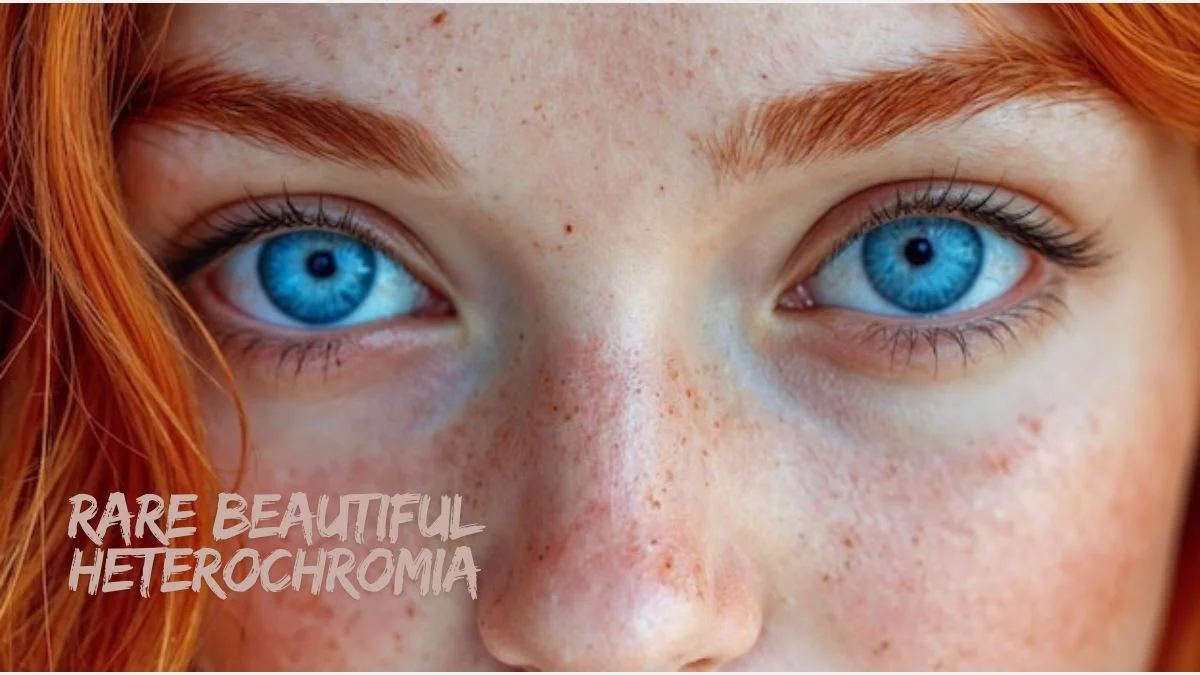
Imagine gazing into a pair of eyes — one a deep ocean blue, the other a warm earthy brown. This is the quiet wonder of heterochromia, a rare and visually striking condition in which the irises of the eyes display two distinct colors. Far from a flaw, rare beautiful heterochromia is increasingly celebrated as one of nature’s most extraordinary genetic gifts.
Whether you’ve spotted it on a celebrity, a beloved pet, or perhaps in the mirror, this guide offers a comprehensive, expert-backed exploration of everything you need to know about heterochromia — its science, its stories, and its timeless beauty.
What Is Heterochromia? A Closer Look at the Condition
Heterochromia iridis — derived from the Greek words for “other” (hetero) and “color” (chroma) — refers to a variation in the pigmentation of the iris, the colored portion of the eye. The condition results from differences in melanin concentration, the pigment responsible for eye, hair, and skin color.
Research indicates that heterochromia is relatively uncommon in humans, estimated to affect roughly 1% of the global population. It is far more prevalent in animals, particularly in certain dog and cat breeds, where it may be considered a breed standard.
The Three Core Types of Heterochromia
| Type | Description | Frequency |
| Complete Heterochromia | Each eye is an entirely different color (e.g., one blue, one brown) | Most visually dramatic; less common |
| Sectoral (Partial) Heterochromia | A segment or ‘slice’ of one iris differs in color from the rest | Likely the most common form |
| Central Heterochromia | Inner iris ring differs in color from the outer ring — often creates a ‘sunburst’ effect | Very common, often unnoticed |
Origins: The Science and Story Behind Two-Colored Eyes
The origin story of rare beautiful heterochromia lies within the intricate interplay of genetics and melanocyte activity. Melanocytes are specialized cells responsible for producing melanin — the pigment that dictates iris coloration. When these cells distribute unevenly during fetal development, the result could be one eye carrying more melanin than the other.
Heterochromia may be congenital (present from birth) or acquired later in life. Congenital heterochromia is often hereditary, passed through genetic variants. Acquired heterochromia, on the other hand, may stem from conditions such as Waardenburg syndrome, Horner’s syndrome, Fuchs’ uveitis, or even physical trauma.
Fascinating Fact: The late musician David Bowie is frequently and mistakenly believed to have had heterochromia. In reality, his eyes appeared different due to a condition called anisocoria — a permanent dilation of one pupil caused by a teenage injury. True heterochromia involves pigment variation, not pupil size.
The H.E.T.E.R.O. Framework: 6 Lenses for Understanding Rare Beautiful Heterochromia
To provide genuine information gain, here is an original expert framework — The H.E.T.E.R.O. Method — for evaluating and understanding heterochromia from multiple perspectives:
- Hereditary Profile — Assess the genetic lineage. Congenital heterochromia is likely tied to familial pigmentation patterns or syndromes like Waardenburg.
- Eye Health Baseline — Undergo a professional ophthalmological evaluation. Research indicates that benign heterochromia typically does not impair vision, but acquired cases may signal underlying conditions.
- Type Identification — Determine whether the condition is complete, sectoral, or central. Each type carries distinct visual presentations and potentially different etiologies.
- Etiology Mapping — Distinguish between congenital and acquired forms. Acquired heterochromia, especially with sudden onset, warrants medical consultation.
- Recognition and Documentation — Photograph and document the iris pattern. This is valuable both for medical records and as a personal archive of your unique trait.
- Ongoing Monitoring — Particularly for acquired heterochromia, regular follow-ups are advisable. Gradual pigment changes could indicate inflammatory or neurological changes.
10 Famous People with Rare Beautiful Heterochromia
From Hollywood stars to legendary musicians, heterochromia has long added to the allure of some of the world’s most recognizable faces. Below is a curated list of documented public figures known to have the condition:
| Name | Profession | Heterochromia Type |
| Kate Bosworth | Actress | Complete — one blue, one hazel eye |
| Mila Kunis | Actress | Complete — one green, one brown eye (corrected via surgery) |
| Jane Seymour | Actress | Complete — one green, one brown eye |
| Dan Aykroyd | Actor & Comedian | Sectoral heterochromia |
| Benedict Cumberbatch | Actor | Reportedly subtle central heterochromia |
| Henry Cavill | Actor | Mild heterochromia noted in documentation |
| Kiefer Sutherland | Actor | Documented complete heterochromia |
| Alice Eve | Actress | Complete — blue and green iris variation |
| Simon Pegg | Actor | Documented heterochromia iridis |
| Christopher Walken | Actor | Subtle heterochromia, documented |
It is worth noting that not every celebrity rumored to have mismatched eyes actually has true heterochromia. From a clinical perspective, the condition must involve genuine melanin-level differences in the iris — not lighting illusions, contact lenses, or pupil abnormalities.
Community & Culture: Celebrating Two-Toned Eyes
The global community around rare beautiful heterochromia has flourished in the digital age. Online spaces — from dedicated Reddit communities and Instagram hashtags (#heterochromia, #mismatched eyes) to YouTube documentaries — have allowed individuals with this condition to share their experiences, connect with others, and reframe heterochromia as a source of pride rather than difference.
Photographers have built entire portfolios dedicated to capturing the nuanced beauty of heterochromatic irises, often using macro-lens techniques to document the micro-pigmentation patterns invisible to the naked eye. Some visual artists have gone further, using heterochromia as a metaphor for duality, perception, and the coexistence of opposites.
How You Can Join the Conversation
- Share your heterochromia story or portrait on social media using #HeterochromiaBeauty
- Participate in ophthalmology-focused forums and contribute to citizen science eye research projects
- Connect with rare genetic trait communities on platforms like RareConnect or genetic interest groups
- Consider documenting your iris pattern with a professional iris photographer — both for art and medical records
Heterochromia in Animals: Nature’s Broader Canvas
While human heterochromia attracts fascination, the condition is arguably even more visually dramatic in the animal kingdom. Certain breeds are predisposed to its expression:
- Dogs: Siberian Huskies, Australian Shepherds, and Border Collies are among the breeds most commonly displaying complete heterochromia
- Cats: Turkish Van, Turkish Angora, and odd-eyed cats (a popular descriptor) frequently exhibit one blue and one amber eye
- Horses: Particularly common in horses with pinto or paint coloring patterns
Research suggests that in some white or merle-patterned animals, heterochromia may be linked to the same genetic pathways that affect pigment distribution in fur and skin — offering a compelling cross-species view of melanocyte biology.
Is Rare Beautiful Heterochromia a Medical Concern?
In most documented cases, congenital heterochromia is entirely benign and likely poses no risk to visual acuity or eye health. However, it is medically important to distinguish between stable, lifelong heterochromia and newly developed pigment changes.
When to Seek Medical Advice
- Sudden onset of iris color change in one or both eyes
- Color change accompanied by pain, redness, or blurred vision
- Changes occurring alongside other neurological symptoms
- A family history of conditions such as Waardenburg syndrome or neurofibromatosis
From a clinical perspective, a sudden or progressive change in iris pigmentation warrants prompt ophthalmological evaluation. Conditions such as Fuchs heterochromic iridocyclitis, pigment dispersion syndrome, or even certain medications (like prostaglandin analogs used for glaucoma) could theoretically cause iris darkening.
Quick Summary Checklist: Key Facts About Rare Beautiful Heterochromia
- Heterochromia iridis involves a difference in iris melanin concentration between eyes
- Estimated to affect approximately 1% of the human population
- Three forms: complete, sectoral (partial), and central
- May be congenital (genetic) or acquired (injury, disease, medication)
- Congenital heterochromia is typically benign and does not impair vision
- Famous individuals with the condition include Kate Bosworth, Mila Kunis, and Jane Seymour
- David Bowie’s different-looking eyes were due to anisocoria, NOT heterochromia
- Sudden color changes in the iris should be evaluated medically
- The condition is far more prevalent in animals, especially certain dog and cat breeds
- A thriving global community celebrates heterochromia as a form of rare natural beauty