
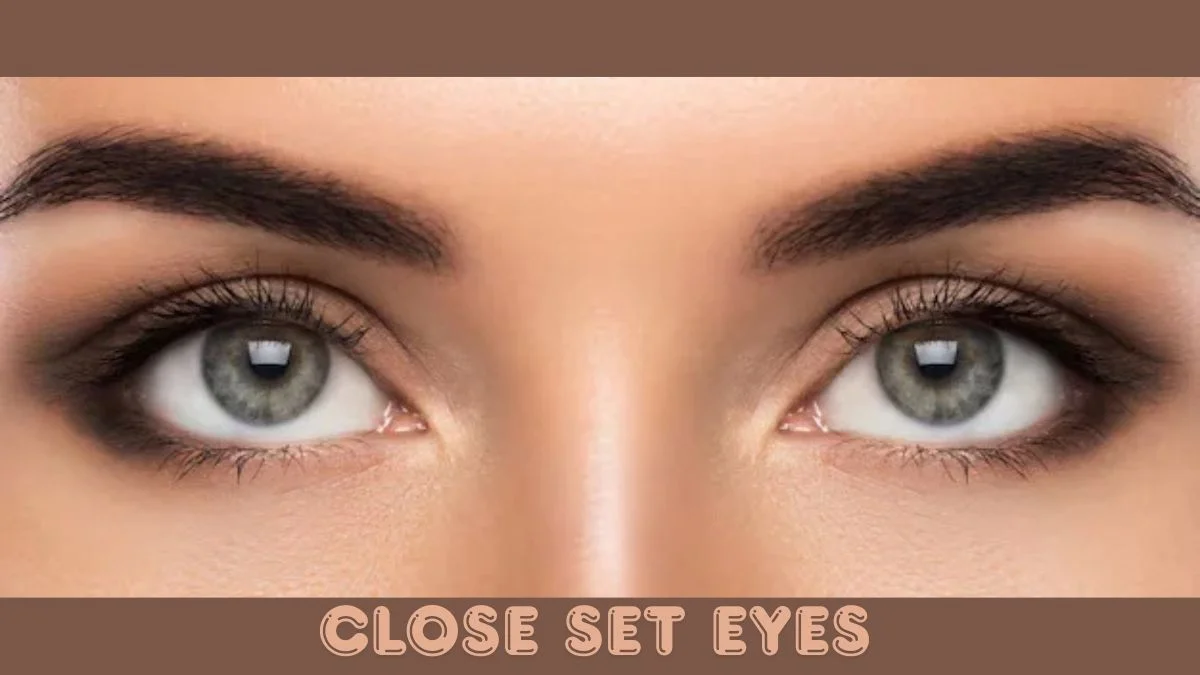
Have you ever looked in the mirror and wondered whether the spacing between your eyes carries any deeper significance? Close set eyes — a term used to describe eyes positioned closer together than average relative to the width of the nose — are far more common than many people realize. Yet they carry a rich history of meaning, perception, and beauty potential that most guides barely scratch the surface of.
In this comprehensive guide, you will discover what close set eyes actually mean from anatomical, cultural, and physiognomic perspectives. You will also find practical makeup strategies, a curated list of famous people who share this feature, and a unique 7-step self-assessment framework to better understand your own eye shape. Whether you are curious, a makeup enthusiast, or simply exploring what makes your face unique — this article is for you.
What Are Close Set Eyes? The Anatomy Explained
Defining the Term
In facial anatomy and beauty science, eye spacing is typically measured using the interpupillary distance (IPD) — the horizontal gap between the centers of both pupils. Eyes are generally classified as close set when this spacing is narrower than the width of one eye, or when the inner canthi (the inner corners of each eye) are positioned closer together than the bridge of the nose is wide.
From a clinical standpoint, the condition of abnormally reduced eye spacing is referred to as hypotelorism. However, it is important to note that most people described as having close set eyes fall well within normal anatomical variation — this is a natural facial feature, not a medical diagnosis. Research indicates that the average interpupillary distance in adults ranges from approximately 54mm to 74mm, and individuals on the lower end of this spectrum may visually appear to have close set eyes.
How to Tell If You Have Close Set Eyes
A simple self-check could involve placing a finger horizontally under one eye. If the gap between your inner eye corners appears narrower than the width of one eye across, you likely have close set eyes. Another commonly referenced method is the three-eye rule in beauty analysis — where a balanced face would ideally fit three eye-widths across the total eye span. Those with close set eyes typically display less than one full eye-width between the inner corners.
The Meaning of Close Set Eyes: Cultural & Physiognomic Perspectives
Physiognomy — the historical practice of reading character from facial features — has long associated close set eyes with specific personality traits. While modern science does not endorse physiognomic readings as factual, these cultural associations have persisted across centuries and continue to influence popular perception. Understanding them offers fascinating insight into how appearance has shaped human storytelling and social judgment.
Traditionally Attributed Traits
- Focus and intensity: Individuals with close set eyes are often culturally perceived as highly focused, detail-oriented, and intellectually driven.
- Strong concentration: Many historical texts link close set eyes with a capacity for deep, sustained attention — traits valued in academics, scientists, and strategists.
- Traditionalism: Some physiognomic traditions suggest that close set eyes may indicate a preference for structure, rules, and conventional thinking.
- Caution and reserve: Close set eyes have sometimes been associated with a more guarded or watchful temperament in historical face-reading traditions.
It is critical to apply the no-guarantee clause here: these associations are rooted in cultural interpretation, not empirical science. They could be understood as storytelling tools rather than definitive personality blueprints. Modern psychology does not support eye shape as a reliable predictor of personality traits.
| Perspective | Interpretation | Reliability |
| Physiognomy (Historical) | Focus, intensity, traditionalism | Cultural / Anecdotal |
| Beauty Science | Facial proportion variation | Anatomical / Measurable |
| Psychology | No established correlation | Scientific Consensus |
| Cultural Mythology | Watchfulness, intelligence | Symbolic / Narrative |
| Fashion / Makeup | Opportunity for optical illusion | Practical / Applicable |
Origins: How the Concept of Close Set Eyes Entered Popular Discourse
The fascination with eye spacing dates back thousands of years. Ancient Greek thinkers, including Aristotle, wrote extensively on the relationship between physical features and character — a tradition that laid the groundwork for modern physiognomy. By the Renaissance, European portraitists were carefully studying facial proportions, and the spacing of the eyes became a central element of the idealized human face.
In the 19th century, Johann Kaspar Lavater’s widely read essays on physiognomy brought eye-shape analysis into mainstream European culture. Lavater described close set eyes as indicators of sharp mental focus — an association that stuck culturally even as scientific skepticism of physiognomy grew. The concept was later absorbed into early 20th century beauty manuals and Hollywood makeup guides, where it transitioned from character assessment to aesthetic strategy.
Today, the term lives primarily in beauty, fashion, and self-discovery communities — places where understanding your unique facial structure is the first step toward celebrating it, rather than judging it. This shift from judgment to empowerment represents one of the most meaningful evolutions in how close set eyes are discussed.
Famous People With Close Set Eyes
One of the most compelling ways to understand close set eyes is to see them on faces we already admire. A notable number of celebrated actors, musicians, models, and public figures likely have this feature — and their global recognition demonstrates that close set eyes are entirely compatible with being considered extraordinarily attractive.
| Celebrity | Field | Why They’re Notable |
| Cate Blanchett | Acting | Academy Award winner; widely regarded as a timeless beauty icon |
| Benedict Cumberbatch | Acting | Internationally acclaimed; known for distinctive, intense gaze |
| Adele | Music | Multi-Grammy winner celebrated for authentic, expressive features |
| Taylor Swift | Music / Entertainment | One of the best-selling artists of all time; signature eye makeup |
| Kristen Stewart | Acting | Known for her intense screen presence and editorial fashion presence |
| David Bowie | Music / Art | Legendary for his striking, unconventional appearance |
| Natalie Portman | Acting | Academy Award winner and beauty industry face |
| Jake Gyllenhaal | Acting | Critically acclaimed actor with a notably focused, intense expression |
Note: Eye shape classification is inherently subjective and based on visual assessment. The individuals listed here are commonly cited in beauty and anatomy discussions in the context of close set or narrowly spaced eyes. These are observations based on widely referenced beauty literature, not formal medical measurements.
The Close Set Eyes 7-Step Self-Understanding Method
To help readers move from passive curiosity to active self-knowledge, here is a unique framework — the Close Set Eyes 7-Step Self-Understanding Method — designed to guide you through assessing, understanding, and making the most of this feature.
- Measure Your Interpupillary Spacing — Use a ruler in front of a mirror to approximate the distance between your inner eye corners. Compare it to the width of one of your eyes.
- Identify Your Eye Shape Type — Close set eyes often overlap with other shape categories: almond, round, hooded, or monolid. Knowing your full shape profile helps refine your approach.
- Map Your Facial Proportions — Assess the overall balance of your face: Are your eyes the widest part? Is your nose wider or narrower than your eye gap? Proportion context matters.
- Research Makeup Strategies — Study contouring, eyeshadow placement, and liner techniques specifically designed to visually widen close set eyes (see Section 6 below).
- Explore Your Brow Relationship — Brow shaping has a major influence on perceived eye spacing. Inner brow spacing and arch height can either accentuate or balance close set eyes.
- Study Faces You Relate To — Look at celebrities, artists, or people you admire who share your eye spacing. This builds a visual vocabulary for your own beauty potential.
- Adopt an Empowerment Mindset — Likely the most important step: recognize that close set eyes are a variation, not a flaw. Many of the world’s most photographed faces have this feature.
Makeup Tips for Close Set Eyes: Creating the Illusion of Width
Makeup artistry offers powerful optical tools for those who wish to visually broaden the appearance of close set eyes. These techniques are widely used by professional makeup artists working with celebrity clients, editorial models, and beauty enthusiasts worldwide.
Core Techniques
- Highlight the inner corners: Applying a light, shimmery eyeshadow or highlighter to the inner corners of the eyes creates the illusion of space by drawing light outward.
- Extend liner and shadow outward: Instead of applying eyeliner symmetrically all the way around, focus the darker shades and liner toward the outer corners to elongate the eye’s visual shape.
- Avoid heavy inner-corner liner: Dark liner close to the inner corners tends to make close set eyes appear even closer together. This is a common technique to avoid.
- Use a light concealer on the nose bridge: Brightening the inner eye area and upper nose bridge with a shade lighter than your foundation can create visual separation.
- Opt for wide-set, arched brows: Starting your eyebrows slightly farther apart than may feel natural can significantly alter the perceived spacing between the eyes.
- Apply mascara strategically: Focus lengthening mascara on the outer lashes rather than the inner ones to draw the eye outward.
Eyeshadow Placement Guide
| Eye Zone | Recommended Application | Effect |
| Inner corner | Light shimmer or white highlighter | Opens and widens visually |
| Outer corner | Dark or smoky shadow | Elongates and draws outward |
| Center lid | Medium transition shade | Adds dimension, avoids flat look |
| Brow bone | Matte highlight shade | Lifts and broadens overall eye area |
| Lower lash line | Nude or light liner on inner half | Reduces visual closure |
Community & Self-Discovery: You Are Not Alone
One of the most rewarding aspects of the modern beauty conversation is how communities have formed around celebrating unique facial features rather than concealing them. Across platforms like Reddit (r/MakeupAddiction), YouTube, and Instagram, thousands of creators with close set eyes share tutorials, tag their photos, and build confidence together.
If you have close set eyes and are exploring how to work with — rather than against — this feature, consider joining beauty communities specifically focused on eye shape diversity. Searching hashtags like #closeseteyes, #eyeshape, or #makeupforeyes on major platforms is likely to surface a growing world of peer-created tutorials, affirmations, and shared experiences. Community collaboration in this space often generates more practical insight than any single expert source. User-generated content from real people with close set eyes frequently includes product recommendations, lighting tips for photography, and emotional support that could be deeply validating for those who have felt self-conscious about their appearance.
Summary Checklist: Everything You Need to Know
| Close set eyes are defined by an interpupillary distance narrower than one eye-width between the inner corners. |
| This feature is a natural anatomical variation — not a flaw or medical condition in the vast majority of cases. |
| Physiognomic traditions historically associated close set eyes with focus, intensity, and traditionalism — though these are cultural interpretations, not scientific facts. |
| Numerous world-famous celebrities likely have close set eyes, demonstrating the feature’s compatibility with global beauty ideals. |
| Makeup techniques such as inner-corner highlighting, outer liner extension, and strategic brow shaping can visually widen the eye area. |
| The 7-Step Self-Understanding Method provides a structured approach to self-knowledge and empowerment around this feature. |
| Beauty communities online offer peer support, tutorials, and shared experiences for those with close set eyes. |
| Always approach appearance-related traits with a mindset of variation and individuality rather than comparison to idealized standards. |